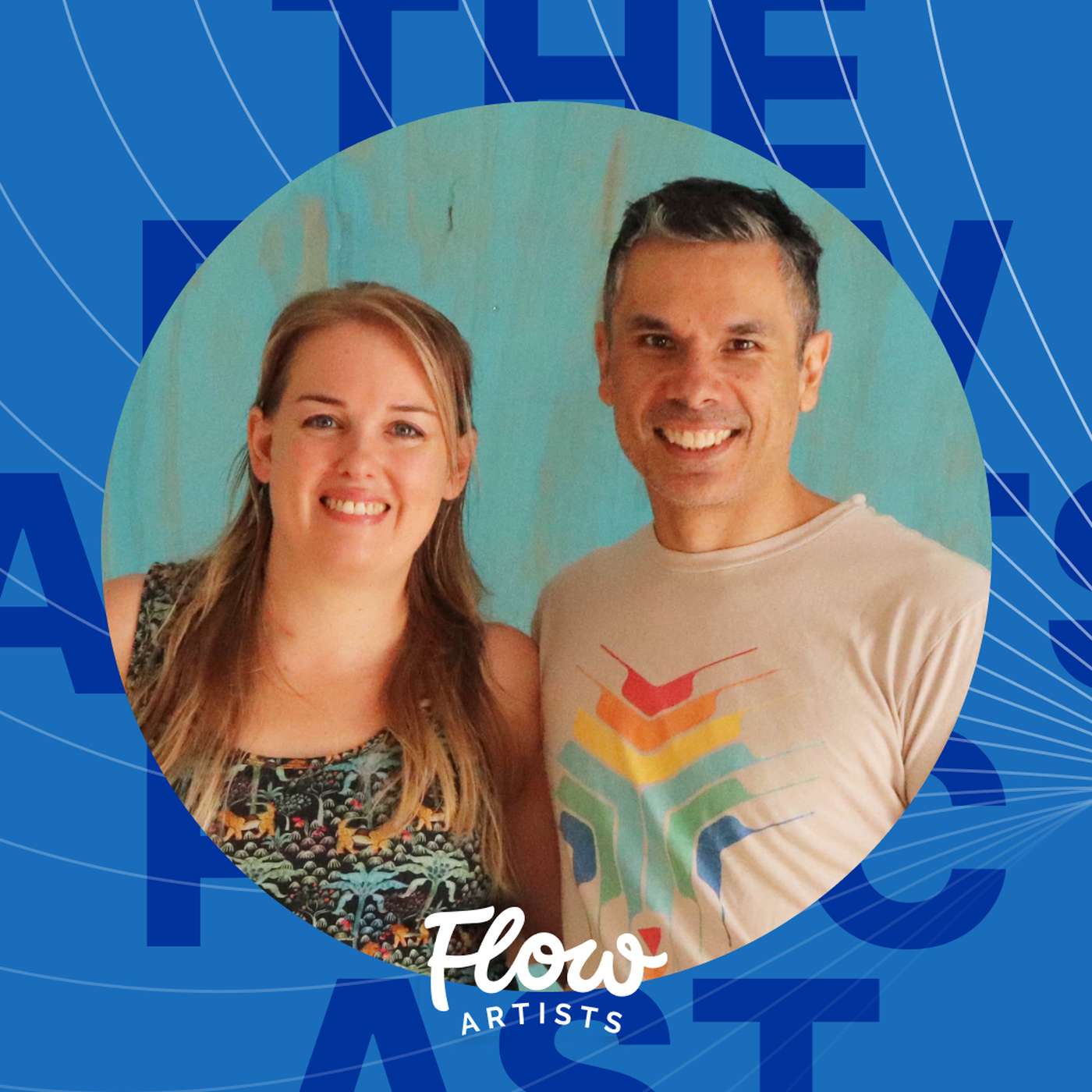
Episode 158
42 mins
Jo and Rane Flow into 2026
We have exciting book news!
Jo's upcoming book "Eight Limbs of Aerial Yoga" is now available for preorder!
As Jo explains with palpable excitement, this book is "a compilation of my life's work in aerial yoga." Her book is structured around Patanjali's Eight Limbs, drawing from interviews with experts, evidence based research and lived experience in a way that honours both tradition and innovation. She candidly shares how "I'd really like my book to kind of help to address some of that lack of in-person community" within the aerial yoga world. For those planning ahead, Jo's Bali retreat is also on the horizon, promising another opportunity to experience her teaching in that magical setting.
In this episode we reach out to our podcast community and have some insightful questions from past guests including Jivana Heyman, Cyrille Caille, Dr Esme Dark, Chloe Prendergast, Nada Todorovich, Claire Holloway and Sasha Sigel.
One of the most touching aspects of this episode is how Jo reflects on her podcast journey and its unexpected connection to her book writing process. "I do feel like the podcast has really paid me back with the book," she shares, highlighting how the relationships and conversations from the show have enriched her writing in ways she never anticipated. The generosity of their podcast community shines through as they discuss how past guests have become genuine supporters, creating what they describe as "that network of sharing." Many past podcast guests feature in the book, including Jivana Heyman who wrote an beautiful foreword.
The conversation takes on a more reflective tone when they explore the delicate balance between teaching and learning in yoga practice. Jo's honest admission that "if I've done a training and I don't teach the things that I've learned in the training, they do not stay in my brain" speaks to a truth many yoga teachers will recognise. This vulnerability around the learning process, combined with their discussion about maintaining humility while teaching, creates space for a really meaningful exploration of what it means to be both student and teacher simultaneously. Their approach feels refreshingly honest in a field that can sometimes feel pressured toward perfectionism.
Perhaps the most powerful moment in the episode comes when they tackle the challenging question of how to maintain inner peace while responding to global crises. Rather than offering simple platitudes, they dive into the complexity of staying grounded while remaining engaged with the world's pain. As they put it, "having the tools to find your own inner peace... can help you have the time and space to respond in a way that's thoughtful and kind." This perspective offers a practical framework for anyone struggling to balance personal practice with social responsibility, suggesting that inner work and outer action can actually support each other rather than compete.
The episode wraps up with a delightful exploration of their unique work-life setup, running a yoga studio connected to their home. Their discussion about creative freedom - "if it's your own space, you can do more things just for fun that don't necessarily need to be profitable" - reveals the joy they find in their unconventional arrangement. Throughout this entire Q&A, what emerges most clearly is not just their expertise or accomplishments, but their genuine care for their community and their commitment to showing up authentically, even when that means admitting they don't have all the answers.
Links
Bali Retreat: https://gardenofyoga.com.au/bali-retreat-2026/
Eight Limbs of Aerial Yoga Book: https://gardenofyoga.com.au/learn/eight-limbs-of-aerial-yoga/
Highlights
Click on a timecode to play from that time in the recording.
Rane: Hello, my name's Rane And I'm Jo and this is the Flow Artist Podcast. Every episode we speak with inspiring movers, thinkers and teachers about how they find their flow and much, much more. How are you, Jo?Jo: I'm good, thanks. I also just want to acknowledge that we're recording this episode today on the unceded lands of the Wurundjeri people of the Kulin Nation. And thank you all for joining us.
Rane: Yeah. So what's been happening, Jo?
Jo: Oh my gosh, so much has been happening, Rane. We went away to New Zealand to go to your sister's wedding with my parents on a road trip. My parents are also invited. It was really fun and really beautiful and a really relaxing holiday.
Rane: Yeah, no, it was great fun.
Jo: While we were away, we had to have some pretty major floor repair works in our house. So, like, the main room in our house had to have its floor lifted up and dug out underneath. And because of where our yoga studio is, that would have meant we'd had to close our studio anyway, so when we got back, had a new floor.
Rane: Yay.
Jo: And less damp.
Rane: Yes. And it's a nice solid floor.
Jo: Yeah. Unlike the old floor, which was very sinky.
Rane: Yep. Yep. So in case you haven't noticed already, this is a Rane and Jo episode from all the Floor Talk and our first episode of 2026.
Jo: Happy New Year.
Rane: Happy New Year. And today it is going to be a 38 degree day in Melbourne. So nice and hot.
Jo: We're staying inside.
Rane: Yes, yes, absolutely. And I guess as in the format of a lot of our Rane Jo episodes, we have asked a few of our former guests and other friends of the podcast to ask us questions which we will endeavour to answer in a fantastic way.
Jo: And thank you so much everyone who sent us questions.
Rane: Yay. All right, should I start with the questions? Well, first up, we have Jivana Heyman. Jivana is a long time friend of the podcast and I think we both consider him a bit of a mentor in the yoga world.
Jo: Total inspiration.
Rane: Absolutely lovely human being. And he has asked us the following question. Hey, Rane and Jo, it's Jivana. I wanted to say hello and congratulations on another year of great podcasts. I love being your guest. Thanks for having me on again and I'm really looking forward to seeing you. I'm actually coming to Australia really soon. Well, in a couple months, the end of April. I just got my work visa, so I'll be teaching there in Melbourne and then Byron Bay. Looking forward to seeing both of you in person. And the rest of the accessible yoga community in Australia that can join me. Either come to the trainings or just come say hi. Just looking forward to being with all of you and visiting Australia for the first time. So I'm really thrilled and I guess my question for you is actually about your book. Jo, I'm so excited that your new book's about to come out. I have the privilege of writing the foreword. It's an excellent book and it's going to be of great service in the world. But my question for you is this, I'm curious, what is your expectation for this book? Because what I found over the years writing a couple books is that I have expectations about the way a book is going to be received and that's often different than the way it is actually received. You know what I mean? Like the intention versus the impact. But it's, I think it's really useful at least for me to really reflect on my goal with each of my books of why I'm writing and, and then kind of being open to how it's received later. Just curious, Jo, what you think, what is on your mind these days about it? How is that feeling for you? So anyway, I'm very excited about the book and about seeing you both. So thanks again and I'll hopefully see you soon. Okay, bye.
Jo: Well, thanks for that beautiful question, Jivana. We're really excited to meet in person. After talking to you online so many times and thinking about the answer to your question, you actually inspired me again. It was in your conversation with Indu, who we'll be talking to our next episode and you described one of her books as a friend. And I would actually love my book to feel like that for the reader. Like one of the things about aerial yoga is it can be quite fragmented. Like for example, I did my training in a different state and my main teacher lives in a different state. And the closest aerial yoga studio that I vibe with is an hour and a half drive away. And I don't think I'm unique in this situation. Like a lot of teachers are kind of doing their own thing and then also people buy the hammock from the Internet and don't even have a teacher. Like they need to be their own teacher. And I'd really like my book to kind of help to address some of that lack of in person community. Someone you can turn to when you've got questions, when you need a bit more inspiration, when you need some support. I'd love my book to be that for people.
Rane: Nice. And do you also think that perhaps it's a way for you to kind of spread more awareness of the type of aerial yoga that we teach here.
Jo: Yes, absolutely. Aerial yoga. That feels like yoga. And I guess articulating some of the connections, like bringing in some of the philosophy in a way that I think I try to do in action, in class, rather necessarily unpacking why I might say things in the way that I do, but in the book, I can really go into those details and also making connections from people who come from different disciplines. Like, there's an occupational therapist and the books are real. Actually, there's a rehabilitation focused Pilates teacher. There are people from other different, different disciplines who use the aerial hammock. And I think that a lot of people who do more of a circus style of aerial yoga, where it is a bit more about tricks, might not necessarily be aware of those therapeutic applications, but there's a lot of potential there. And I do feel like it's the most exciting part, the varial yoga, to use the hammock in a therapeutic way. So I really want to share those perspectives in my book and hopefully just open people's eyes to some of the possibilities.
Rane: Beautiful. And as Jivida did mention, he'll be in Melbourne very soon, in Sydney, so we'll leave some links to book into that in the show notes.
Jo: Yeah. And I'll be assisting in the Melbourne training.
Rane: Oh, nice.
Jo: Yeah. So excited about that.
Rane: Cool. Cool. All right, so our next question is from Cyrille, who has been on our podcast before and also a friend of ours, Eliza. And they ask, do you and Rane have anyone in particular on your list of people you would love to interview for the podcast? And if so, what inspires you most about that person?
Jo: So I got the eternal podcast dream guest, Justina Blakeney, who's a real design inspiration for me. And also I just find it very inspiring way that she has created her own business around creativity. And she's got a new book out, so maybe I've got another chance. I've messaged her in the past. I'm still trying. Also, Valerie Kaur. I was really inspired by her book See No Stranger. She shares a lot of seek philosophy, and I think for anyone who's just kind of confounded by all the really intense, heartbreaking stuff that's going on in the world right now, globally and in Australia. And just how do we respond? Like, she has a really wonderful framework of maintaining our humanity, maintaining our compassion, but also like action and conviction. And I love the way that she expresses all of that in her book. I'd love to speak to her on the podcast. I've been a little bit hesitant to approach her because she's a movement lawyer and she's, like, doing these really big things, these really powerful actions. She seems really busy and does she have time to go on our little podcast? I guess it doesn't hurt to ask.
Rane: Absolutely. So, on to our next question. Jo, you were able to lead your first aerial yoga retreat in Bali in August 2025, and the next one is coming up soon in 2026. I think you've already shared a little bit about your experience in previous episodes of the podcast, particularly the things you might do a little bit differently. But if you could mention just one thing that made the most positive impression on you during this experience, what would it be?
Jo: It was actually floating leaf. Both the venue and the staff, like, they were so amazing. They were so supportive, they were so generous in how they shared about Balinese culture and really welcomed us in. And I just had a lot of, you know, when you. I don't know if you've been to Bali, but it's like, say, the little floral offerings that you see everywhere, to be able to learn what each of the flowers represents and how to make the basket and what the intention that goes into that practise. All of those layers of these things that you might just see and think are beautiful visually, like, have a lot of deeper meaning in Bali. And it was really amazing to be able to, like, learn about that. They supported me so much as a facilitator. Like, I've heard other people say how tired they were after leading their retreats. I didn't feel like that at all. Like, I felt like I'd been pampered as well. They just put so much energy into making sure that I had a really great experience so that that would flow out to the students. And even just the, like, thoughtfulness that had gone into the design of the venue, there was very little hard corners. Like, everything is round. So it's kind of like a visual hug from the building and it's all based around this amazing garden and pool, but then also, like, a big, long table that we all sit at for all of our meals and that we have the, like, the learning sessions and the workshops from the staff there. Like, that feels like a real kind of heart of the venue and it was, like, lovely to experience that. So, yeah, I would actually say that the most positive part of the experience that surprised me. Well, not surprised me. Like, I thought it was going to be good, but I'D never visited in person. They found me online. So it was just above and beyond any expectations that I might have had and it was really amazing. My next retreat is coming up July 15th to 19th, 2026, and we do have an early bird sale which ends February 14th. So great time to get in there. And just to let you all know, I'm not going to do a Bali 2027 retreat. I've got some big dreams for 2027 and I need to make some space for them. So if you are thinking this is the year and I can't wait to share this amazing place with you and everything I've learned from the last retreat that I'll be building on in this retreat. Yeah, really excited about it.
Rane: Great. So we have another question from Cyrille. Thanks, Cyrille, for all these questions. So, Jo, you're about to publish your book and in all caps she's put when will it be released? And four question marks. I can't wait to read it. Would you like to share a little bit about the process of creating this book?
Jo: Yeah. So in the time between Cyrille sending us this question and recording this episode, Cyrille actually found it online. Like, it's available for pre order, which is something I hadn't heard from the publisher, Singing Dragon yet. So that was cool. And I must admit I Googled myself to find all the places that it was available online. And one that I was particularly excited about was actually at Readings, which is a really iconic independent bookstore in Melbourne. And I would see them as a bit of an arbiter of good taste. So to see that my book was available for pre order on their website felt like a real endorsement from, like, I guess the most iconic Melbourne bookstore, like, that's amazing. But it's actually available for pre order on a lot of websites. So if you don't have a really cool local bookstore that you want to pre order it from, there's so many options. It's called Eight Limbs of Aerial Yoga Adapting Practise for Neurodiversity, Accessibility and Physical Support. The Release date is April 21st and I had a little bit of a question about this, which I haven't heard back from Singing Dragon yet. I believe it takes another six weeks for the Australian books to get to Australia, so obviously I want them here before I have a release party. So otherwise, like, the guest of honour is not there yet. Yeah. Oh, about the process of writing the book. So I did a few different things and it was a long process. It was like two years in total. One of the things That I did, which is a little bit inspired by the podcast, is I sent written interview questions to people like Cyrille, who's an occupational therapist who uses aerial yoga with her clients and also teaches aerial yoga classes outside of the traumatic brain injury space. Renee Stevens, who is one of my main teachers. There's a whole lot of different contributors who I sent my written interview questions to as well as people I know from my home studio. And I had some like I wanted to share lived experiences in the book as well as published research. I did do as much looking as I could online to see what evidence based research there was about the benefits of aerial yoga. And I couldn't find a lot personally. So I'm really grateful to Audrey, who is of performance Pilates, who uses aerial yoga like an aerial yoga hammock with her Pilates clients. And she's a physiotherapist as well. She actually shared a lot of evidence about the benefits of traction for the spine and dealing with chronic pain and even working with hypermobility. The main structure of the book though was actually Patanjali's Eight Limbs. So I kind of based it around that and that kind of gave me the framework for bringing in the different aspects of aerial yoga teaching and practise, especially for Asana. Chapter is really long, but even other things like Satya and Satya, like all of the eight limbs and Yama and Niyama as part of that contributed a really wonderful forward. And the way I wrote it was pretty fragmented, I guess, Like I just wrote lots of different chapters based on whatever I was in the mood to write about that day. And that meant I ended up writing about twice as many words as what I proposed. So then there was a long editing process as well. There's a lot of photographs in the book as well, like about 300 images. So that was its own set of writing out the descriptions for the pose, really thinking about what photos I needed to show those different steps of getting in and out of each pose. Especially since one of the people who I wanted to speak to were people who were new to aerial yoga and didn't have a teacher. I do recommend that they at least have a friend nearby in case they do need assistance or feel dizzy or just get confused as to how to get in or out of the pose in the hammock, so they have a helper with that. But I've really tried to structure things in the way that there's foundation levels and you build it up gradually so that hopefully people are comfortable and able to get themselves in and out of every pose, just by building up levels of challenge and, I guess, intensity as well. With these poses, a lot of them, you can practise low to the ground or higher up. I've tried to structure it as well, kind of the way that I teach in class. So if I'm thinking about what benefit do I want people to get? So say I want to give people a stretch that's going to stretch out their glutes. Because a lot of my clients come from working at a desk all day and they come in with sore hips and lower back. So sometimes you could, say, have the hammock behind you, hold it with both hands, your knees are bent, and go for an ankle to thigh glute stretch from there. That's a great option if people need a bit of support with their balance, or if they just want to, like, settle in a bit more and be able to move around in lots of different ways. And so it's not so much about the balance, it's more about just having that freedom to find the best angle that works for you in that pose. Or you could do something like a standing pigeon pose, where you're standing on one leg, you put your other leg in the hammock and you bend your knee and you can still move that leg around and find different angles. But because you are standing on one leg and you also have just the balance challenge of putting your other foot in the hammock, that's more suitable for people who are going to be comfortable maintaining their balance as you make your way through those different steps. And often I would have people in class who need both options, someone who wants that extra challenge of the balance with the stretch, and someone who needs the support of the hammock so that they can just focus on the stretch and not worry about maintaining their balance. And so kind of thinking about, like, what's the goal of the pose? And then how can I use the hammock in different ways so that different people can get what they need out of the practise in a way that's not too confusing for everyone. So it still feels like we're all working on a similar thing, even if it looks different from the outside.
Rane: Nice. And I guess also recently you just received your proofs for the book.
Jo: I did, yeah.
Rane: Yeah. So there's a little bit more of an editing process there as well. Or just sort of final corrections. Yeah, yeah.
Jo: And a big part of that was actually the photo. It's like checking that the right photo had the right caption and the right alt text to go with it as well. And like I still noticed some things in say the way that I expressed a couple of sentences that I wanted to change. And there were just questions as well. Like sometimes in the written interviews I had a few different people who English was not their first language so you know how much is appropriate to edit their answer. And all those people would be like edit my answer. So it makes sense. So it wasn't about a trust thing. Like I wanted to clearly represent what people were trying to say. It was just about clarity.
Rane: And this is a question from me. What has been your most favourite part of this whole writing process? Sorry, I just sprung that one on you.
Jo: I was saying like as I was writing the book. The best part of writing the book is talking about writing the book. So it's definitely like something fun to talk about when people ask what you've been doing. And I think the kind of feeling of a bit of accumulation of my life's work.
Rane: Yep.
Jo: Like when you're just doing your own thing on your own, sometimes it doesn't really particularly feel like it's a progression. Like I really love the day to day experience of teaching and like we just have a small business. Like it's not like when you have a job and you get promotions and you get like different, you know, roles and things. Like it's the same. So being able to do something big like this that kind of brings together like everything that I've learned over probably almost 15 years of aerial yoga teaching and I guess like a reason to connect with other people as well and share their insights. Like it's felt like a really great kind of accumulation and expression of like the stuff that's really important to me about doing this work, the stuff that inspires me, the questions that I might have. It's kind of given me a bit more of an impetus to dig a bit into, you know, into those answers and those reasons.
Rane: Yep. So yeah, yeah, nice, nice. And yeah, like you mentioned, I think it's sort of, I guess it sort of brought everything together and I know you did a lot of research and stuff as well and I, I just personally I've noticed I can just sort of ask you a question about anything yoga related and I know you'll have a very informed. Backed by evidence, opinion.
Jo: So yeah, I don't have all the answers. No, I have opinions.
Rane: Yeah, yeah, we all have opinions. Yes. But yeah, no, it's great to see and yeah, I'm looking forward to when this book comes out.
Jo: Thanks. And I should have. Like, I really enjoyed the writing process as well. Like, I don't know, maybe I'm just a big nerd and I haven't written school assignments for a while, but it was kind of cool. Just like writing about, you know, stuff I was really interested in. But I am someone who needs a bit of a deadline or, like, I don't just write for inspiration. Like, I need a kind of goal with it. Same as making art. Like, if you have an exhibition, like, it really propels you to work a lot more to that date.
Rane: Yep, yep, absolutely. And in case people out there don't know, Jo's. Jo's mother is a biochemist and her father is also a science teacher. So there's a bit of a scientific background going on there.
Jo: Yeah, yeah. My mom has a PhD.
Rane: Yeah. Yeah. That's awesome. Well, thanks for those questions, Sorel. Next we'll move on to some questions by Chloe Prendergast, who's also been on the podcast. And her first questions are, can you talk about some awkward podcast moments?
Jo: Yeah. So this has happened to me way too many times, but oh my gosh, like, navigating daylight savings globally is not my talent. Like, I've stuffed that up in so many ways. Our daylight savings has changed since we booked the interview. The interview, guests daylight savings has changed. Like, too many times people have sent an email to be like, I'm online, like, are you ready? Like, are we interviewing at this time? So now I know about timeanddate.com so I hope that this is a thing of the past, but yeah, it's not a good way to start the interview. And for some reason it always seems to be the interviews that are early morning for us to fit in with someone else's time. So not only are we a bit flustered because we kind of stuffed up time wise, but not being natural morning people, then we've got to really do a good job in that interview to make up for not being good at time and date calculations.
Rane: Yeah. And I guess, yes, obviously there is software out there that can actually book people in with the different time zones, but it's, you know, subscription based and I don't, I just don't think we'd make enough use out of it to be able to use it.
Jo: And now I've also learned to not ask people where they live, but to ask them what their time zone is, because that can help.
Rane: And our next question is, have you or who are your favourite guests or interviews and why?
Jo: Well, I've got to say, Jivana is a favourite guest of ours. We love speaking to him. Always a really great way to I guess feel like re engaged and re inspired about life and yoga and yeah, love those interviews speaking to Anjali as well. Those have been a couple of my favourites as well. Like also very inspiring and especially since the most recent one was about her book that I've just finished writing my book so I got to ask some. Some writer questions and I loved her answers. And yeah, it's like such an honour to speak to these people who are kind of some of my literary heroes and my yoga heroes.
Rane: Nice.
Jo: It's amazing.
Rane: Yeah. And yeah, I'll just back jump there. Jivana. Yeah, always been a great guest. He's been very generous with us. Anjali. I was just sort of thinking back to some of our earlier interviews. I mean, I guess anyone that was kind enough to speak with us when we hadn't really recorded anything. So yeah, yeah, so pretty grateful about that.
Jo: And like some really amazing authors like Michelle Cassandra Johnson and Gail Parker. Like, yeah, such an honour.
Rane: Yeah, absolutely. And Chloe's final question is how do you stay motivated and inspired to keep going?
Jo: So I think the best way to do that is to only choose to speak to guests who you are actually really excited to speak to. I think that anyone who has been doing a podcast for a little while knows how many emails you get that look very copy and pasted and they're not really. They might be people from the yoga world, but no one whose book I've read personally or after reading that copy and pasted email, like I feel called to follow up. So I think that there is a lot of people who will start to get in touch with you, but maybe to just be quite discerning about who you want to speak to because it's a few hours of research for me. Like I'm probably pretty slow at it if, especially if someone's written a book, like I do really like to read their book before the episode before I speak to them about their book. Apparently that's rare, but yeah, it seems kind of disrespectful otherwise. So, you know, I want to be into the book and then that's where the inspiration comes from. Like it's just the genuine questions that I've had while reading the book and things that I want to know more about and unpack more. Like that's the stuff that I find really exciting sometimes they're people who are just really inspiring and I want more people to know about and I feel like that's Quite motivating. Like, say Nada, who we spoke to pretty recently, who was just. I love what she does with her business. Every time I went into her shop, we always had a great conversation. So I was inspired to speak to her on the podcast for that reason. So it doesn't have to be authors, it's also just people who you're like, wow, you're a really interesting talker. Like, I think that you would make a great podcast guest.
Rane: Nice.
Jo: How about you, Rane?
Rane: Oh, look, I think in a way I'm just too stubborn to stop and you know that this is a fun project that we do together. And, yeah, I really enjoy it.
Jo: And actually, I do feel like the podcast has really paid me back with the book. Like, I think that it really helped me both in making connections, because Donna Noble, who we've had the pleasure of speaking to a couple of times, actually connected me to Singing Dragon. And a lot of the experts that I spoke to in the book, I knew from guests, like being on the podcast as guests, and I think the in depth way that I read people's books, if I'm going to be speaking to them and kind of how I'd make notes about that and then how I'd ask those questions kind of helped inform the way that I wrote my book because I'd just done all of this writing study.
Rane: Nice. So, next we move on to a question from Esme Dark, and we will play that right now.
Jo: Hi, Jo And Rane, it's Dr. Esme Dark here. Gosh, so much has happened since I came on your podcast. Psilocybin assisted psychotherapy and MDMA assisted psychotherapy have been rescheduled, which means that they're able to be used under the guidance of an authorised prescribing psychiatrist for particular mental health conditions, which is fantastic news for the community, but there's still a lot of challenges with cost and access. So we're really working on that as a psychedelic therapy community in Australia to try to improve those processes and make it easier for people who really needed to get these treatments. I've also started beyond the Tripp podcast, which people can cheque out, that's all about psychedelic assisted psychotherapy, which has been really fun. It's been going about a year now. And here's my question, which is kind of related to that, actually. Without you and Ron and the support that you gave me, I wouldn't have been able to get beyond the Trick podcast off the ground. So what support has been the most helpful for you in your journey to creating a Podcast and putting it out in the world. And how do you think the wider podcast community could support one another in an ongoing way? All right, thanks both and hope you're doing well. Hey, thanks, Esme. So great question. And also, we love speaking to you on the podcast. Thank you so much and so exciting to hear how your podcast has just grown and flourished. And highly recommend listening even if you're not personally curious about psychedelics or psychology. Esme's guests are all great speakers, and I think if you're listening to our podcast, you're probably pretty interested in learning about how the mind works. So there's a lot of that in there. When it comes to how the podcast community can support each other. Someone who is really helpful for us as we were growing was actually Cora Geroux, and she put us in touch with Shay, who's our amazing editor who fixes all of our stumbles and takes away all of our mouth sounds. So thank you, Shay. And she was just super generous sharing that connection. Jivana has been really generous in his sharing. Like, he's often got in touch with people who he think would be great guests on our podcast and I really appreciate that. And our other. We've had some other past guests who've done that as well. Like, I love that network of sharing. I will just say my favourite way to hear about a guest is a personal email just to me to be like, I think this person would be a great guest on your podcast. Would you like me to put them in touch? It's slightly more awkward when it's a group email and they are like saying, oh, this person will be great on your podcast. And then you have to say no to the person if you don't feel the same way. And Jibina has never done that. But yeah, I do appreciate the separate emails to see if each individual party would be interested before the connection email.
Rane: Nice. And yeah, no, I feel like there's plenty of ways the podcast community can support each other. And I do think that for one, like, you know, everyone who wants a podcast should be able to have one. And I think the technology is pretty easily available to do that nowadays. And I guess some ways that you can support other people's podcasts is just by listening to them. If you happen to be a guest on a podcast, you can be a good guest and how promote that that podcast episode.
Jo: Yes. If you don't share your episodes, the podcast will wonder if you liked can be a little bit unsettling.
Rane: Yep. And, you know, just liking liking them on social Media, that all that sort of thing, every, every little bit helps. So. Yeah. And just. I know, Keeping in touch.
Jo: Yeah, absolutely. Actually, even just like posting comments when we share about our episodes, that goes a long way as well. We love that. We really appreciate it. We have fragile egos. We need constant reassurance.
Rane: Yes. Yes. So thanks, Esme. Our next question is from Claire Holloway and she asks, yoga is an infinite body of wisdom and the call to remain a student is lifelong. How do you navigate the tension between the humility of constant study and the self trust required to teach from your own lived experience?
Jo: Great question, Claire. So I find for me personally, if I've done a training and I don't teach the things that I've learned in the training, they do not stay in my brain. So I feel like that's quite a good integrator for me, the process of internalising what I've learned and sharing it and I guess in some ways making it my own. I definitely do try and credit the teacher that I've learned it from, especially if it's a new training. And just budget wise, I feel like one training a year is probably my max. So that's also a deciding factor of how much study I'm going to do if it's a paid training. And there's always going to be more to learn. So I think that really giving yourself that time to kind of integrate each offering before you push more on your plate is a good way just to get the most out of each of these trainings. Like sometimes the lessons don't land until you're sharing it yourself and then you'll kind of understand it in a more experiential way.
Rane: Nice. And you know, I guess I'm also a person who learns best by doing and I guess I always start with the assumption that I'll be not very good at something, but you just kind of have to jump in anyway and be open to learning all the time and try and improve. And I think gradually you will improve. So yeah, that's what I do. All right. We have another question from Nada. Nada is the owner of Dragonfly Cafe. We spoke with her a few episodes ago. It was a really great episode. And she asked the following. I've been thinking about what I could ask, as I initially thought there was nothing. Then, in light of increasing constant background awareness of the state of the world, my question is then in brackets. It's a heavy one. How do you deal with the increasing awareness that our society slash democracy is under threat of collapse as Fascism continues to rise here and around the world. There's not enough yoga that you can do for this.
Jo: I mean, there's definitely not enough yoga you can do to be okay with it. And it's actually people from the yoga world who I turn to when it just feels too depressing. And Jivana is a really great example of this, of how to, like, look into yoga philosophy to find the inspiration to be a force of positive change in the world. And one of the things that I've learned from him is if there's something huge globally going on, like, what can you do closer to home in your community that could be helpful? Like, that feels like a way of taking positive action when something is out of your hands. Like, what could you do at home to even create a small sense of working towards the kind of world that you want to live in? Valerie Kaur, her book was really amazing in that way as well. Like, just not losing touch with your humanity. Even if you're really sad, really angry about the world and when there are other people behaving in a way that's really hateful. Like, how do you, like, turn away so you can look back or, like, take a breath so that you can return with more energy? Yeah, like, I didn't explain it as well as she does, but I found her book really powerful in that regard. And even just like here in Australia with like the new law that's just passed where, like, and now it's a crime to speak out against genocide. Like, it's wild. And I think that there is some justified criticism of people in the yoga world turning to their practise to feel okay personally when it's okay not to be okay right now, like, there's so much going on in the world and it can often be kind of selfish to focus on protecting your own peace. But at the same time, if you are living in a state of emergency and you can't sleep and you can't function, no one's nervous system is designed to be able to function and be productive and to be kind and to just continue to exist in that high level of emergency stage. Like, it's designed, our bodies are designed to have like that burst of energy and then hopefully get to a state of safety where we can downregulate again. And obviously someone living in the war zone does not have that privilege. But I think that having the tools to find your own inner peace and then to hopefully draw from that, or just the tools to be in a slightly less panicked, highly activated state can help you have the time and the space to respond in a way that's thoughtful and kind and not coming from stress and panic. I don't know if this is helping, but these are things that I think about, and these are also the things that I try to offer the people who've come to my class, Especially if something really intense has happened in the world that day. I don't necessarily want to, like, tell people to relax because sometimes that's not realistic and it can be quite jarring. But to maybe help people feel a little bit more okay inside and to be kind to themselves when it's really heavy times at the moment, I feel like sometimes that can be more of my role.
Rane: Beautiful. And. Yeah, I don't know if I could put that any better myself. I. Yeah, wholeheartedly agree.
Jo: And I think as well, sometimes it's also good to do things that feel productive that maybe. Yeah, I get. Like, I've got a big stack of leaflets from the Greens that I'm gonna go and deliver as soon as the weather is cool enough. So I think try to do lots of different little things, all the different ways that you can think of, and to try and be that little ripple that goes out into the big world.
Rane: Yeah. I guess just take a little bit of time to look after yourself so you can, you know, be part of the world without hiding, without compromising your values.
Jo: Yeah. And I guess, like, take time to be with the people that you love.
Rane: Yeah.
Jo: And tell them that.
Rane: Yeah. Beautiful. All right, our final question is from Sasha, and she says, with your yoga studio being connected to your home, how do you set boundaries between work and home life? What are the benefits and challenges of your setup?
Jo: Well, I think in class, it's pretty much the same strategies that I'd use to set, like, kind, professional boundaries as I would in a class outside of my home. Like, if it was an office or a private class. Like, I think all of that stuff pretty much translates to a home studio. I will say it helps us that our studio is in a different building to our house and that people don't need to walk through our house to get to our home studio. I'll also say as well, I might feel different about this if I was a single woman living on my own. Like, having Ron here, who's a really visible part of my business, I think I might not feel as safe to have it quite so obvious that, like, my house is right there and all my students kind of know where I live. So that is a different situation. That is a bit of A privilege.
Rane: We do have a couple of scary looking cats as well.
Jo: And I think probably the biggest thing about having your business at your house is if you really want to have something that feels like a holiday, you kind of need to leave your house as well. And it's not just studio business. Like we've both got multiple projects as well. And I don't know if any other self business people who are also creative have this challenge where sometimes if you've got like say a whole weekend free, you'll just like dive into a project and go really hard on that and it'll be really satisfying and really fun and really fulfilling and then you'll get to the end of the weekend and you'll be quite physically exhausted from your project and then your work week begins.
Rane: Yeah, I guess for me it's quite easy because I work from the office four days a week.
Jo: So yeah, I'll talk about the benefits. Like there are so many benefits. I don't think my yoga business would have survived Covid at all if I was renting a space that was separate from our space. It's also a really cool benefit to have like a big open space for creative projects. Like I can really spread out and like I recently had a little art exhibition in the home studio and if I was hiring a gallery space and launching an exhibition there, I might not have done it because I just have that extra cost and extra stress. But if it's your own space, you can do more things just for fun that don't necessarily need to be profitable because you're not like meeting the cost of hiring a space. So there's a bit more openness for that built in. All openness as well for like exchanges, if we'll say like Meah, who I collaborated with for the art exhibition, she swapped her creative dance class at the studio, which is great because I could go to the creative dance class as a student. And then she stretched my artworks for the exhibition, which is a project process involving rice, glue and glass and water and like intricate work. So that was a really good energy exchange, which you know isn't as possible if you're hiring a venue. So there's a lot more scope to do things that are creative and fun with a layer of financial pressure taken out of the equation.
Rane: Nice. Well, as I mentioned, that's all our quiz questions. So before we leave, is there anything else you wanted to talk about? Jo?
Jo: I've spoken about the book, I've spoken about Bali, if you'd like to know more about either of those things. Feel free to get in touch. That would be great.
Rane: And we'll leave links in the show notes as well.
Jo: Yeah. And thank you so much to everyone who's sending questions. Thank you so much to everyone who listens. It really means a lot. We really appreciate it.
Rane: Thank you so, so much for listening. Aroha nui. Big, big love.
Friends of Flow